
Top Cybersecurity Risks for SMEs (And How Accountants Protect You)
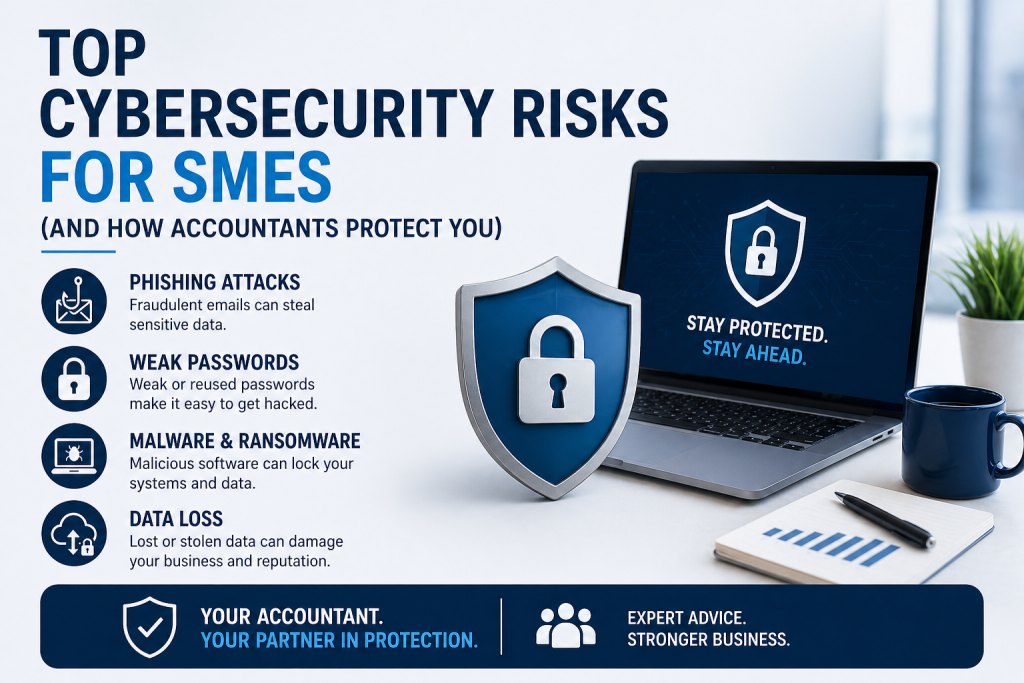
Cybersecurity is no longer just an IT problem — it’s a financial, legal, and operational risk, especially for small and medium‑sized enterprises (SMEs). While large corporations make headlines after cyberattacks, SMEs are far more likely to be targeted, often because they lack formal security controls.
What many business owners don’t realize is that accountants play a critical role in cybersecurity protection. From financial controls to compliance and process design, accountants are often the first line of defense.
Below are the top cybersecurity risks facing SMEs — and how accountants help protect your business.
1. Phishing and Email Fraud
The Risk: Phishing emails trick employees into clicking malicious links, downloading malware, or revealing sensitive information such as login credentials or banking details. SMEs are prime targets because they often rely on email-based approvals for payments and payroll.
Real‑world impact:
- Fake supplier invoices
- Unauthorized wire transfers
- Compromised email accounts
How Accountants Protect You:
- Implementing segregation of duties for payment approvals
- Designing dual-authorization controls for bank transactions
- Reviewing unusual payments during reconciliations
- Training staff to recognize financial red flags in emails
Your accountant doesn’t just look at numbers — they look for patterns that don’t belong
2. Weak Internal Controls
The Risk: Many SMEs rely on trust instead of formal controls. One person may handle invoicing, payroll, banking, and reconciliations — creating a perfect environment for fraud or cyber exploitation.
Why it’s dangerous:
- Errors go undetected
- Cybercriminals exploit single‑point access
- Insider threats become easier
How Accountants Protect You:
- Establishing strong internal control frameworks
- Ensuring role separation between accounting, payments, and approvals
- Regularly reviewing system access and permissions
- Documenting financial processes
Good accounting controls reduce not only fraud — but cyber exposure as well.
3. Ransomware Attacks
The Risk: Ransomware encrypts your business files and demands payment to restore access. SMEs often lack proper backups, making them more vulnerable to operational shutdowns.
Consequences include:
- Lost financial data
- Downtime during tax season or payroll
- Regulatory penalties if data is exposed
How Accountants Protect You:
- Ensuring regular, secure backups of financial records
- Verifying disaster recovery plans for accounting systems
- Advising on compliant record‑retention policies
- Helping businesses assess the financial risk of downtime
Accountants help you prepare financially, not just technically.
4. Payroll and Direct Deposit Fraud
The Risk: Cybercriminals frequently target payroll systems by impersonating employees or executives and requesting bank changes.
Common scam:
“Hi, this is urgent. I need my direct deposit updated immediately.”
How Accountants Protect You:
- Enforcing change‑verification procedures
- Prohibiting payroll updates via email alone
- Reviewing payroll audits regularly
- Spotting anomalies before funds are released
Payroll fraud directly hits your cash flow — and your employee trust.
5. Cloud Accounting System Vulnerabilities
The Risk: Cloud platforms like QuickBooks, Xero, or Sage are secure — but misconfigured access can expose your data.
Risks include:
- Former employees retaining access
- Shared logins
- No activity monitoring
How Accountants Protect You:
- Managing user roles and permissions
- Conducting periodic access reviews
- Monitoring unusual login or transaction activity
- Ensuring compliance with privacy regulations
Technology is only as secure as its configuration.
6. Compliance and Regulatory Exposure
The Risk: Data breaches can trigger serious legal and financial consequences — especially under regulations related to privacy, tax, and payroll records.
For Canadian businesses, this may include:
- PIPEDA violations
- CRA audit triggers
- Reputational damage
How Accountants Protect You:
- Ensuring compliance with financial data protection laws
- Advising on proper document storage and retention
- Supporting audit readiness
- Acting as advisors during breach response
Accountants translate cybersecurity events into financial and compliance language.
Why Cybersecurity Is an Accounting Issue
Cyber incidents ultimately result in:
- Financial loss
- Business interruption
- Tax and reporting challenges
- Legal exposure
This makes cybersecurity a core part of financial risk management, not just an IT function.
Accountants protect businesses by:
- Strengthening financial controls
- Detecting fraud early
- Ensuring compliance
- Advising on risk mitigation strategies
Final Thoughts
SMEs don’t need enterprise‑level security budgets — but they do need smart controls, oversight, and trusted advisors.
Your accountant is uniquely positioned to:
- Identify financial weak points
- Reduce cyber‑related risks
- Protect your money, data, and reputation
Cybersecurity isn’t just about firewalls — it’s about financial discipline and accountability.
Sources & References :
- Qualysec. Small Business Cyber Attack Statistics [qualysec.com]
- StationX. Small Business Cybersecurity Statistics 2026 [app.stationx.net]
- Heimdal Security. Small Business Cybersecurity Trends [heimdalsecurity.com]
- Association of Certified Fraud Examiners (via Thomson Reuters) [tax.thomso…euters.com]
- Varonis. Ransomware Statistics 2026 [varonis.com]
- ResearchGate. Internal Controls in SMEs